SaaS Capital Blog

SaaS Median Operating Margins vs Interest Rates

Featured

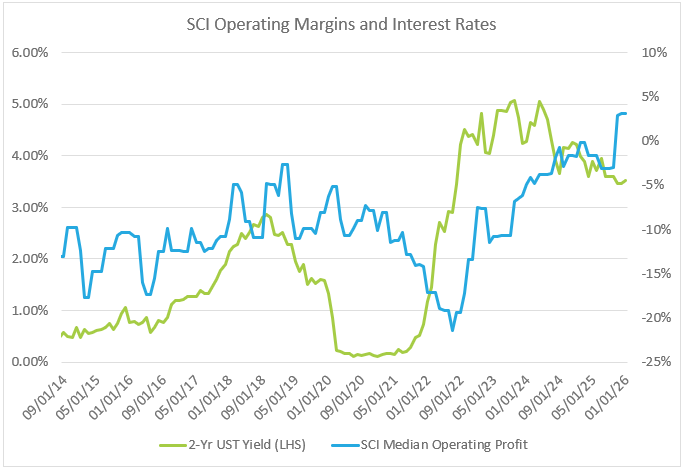
An Evolution in SaaS: The Median Company has a Positive Operating Margin

For the first time in over a decade, the median publicly traded SaaS company is generating a positive operating margin. This post examines the trend, its relationship to interest rates, and what it means for evaluating which companies are best positioned to navigate an uncertain environment.
My AI is Lazy: AI Created Fake Backlinks to Our Site. Here's What SaaS Marketers Need to Know

AI content tools are churning out huge amounts of content daily. Much of that content includes citations, references, and backlinks. And some of those links are hallucinations: plausible-looking URLs that lead nowhere. For SaaS companies, this creates several problems.

Introducing the SaaS Capital AI Assessment Framework

The wide availability beginning in 2025 of Artificial Intelligence (AI), and in particular the generative models known as LLMs, has given rise to fevered speculation as to the potential effects on the Business-to-Business Software-as-a-Service (B2B SaaS) market. SaaS is not dying, and a single generalist AI model will not replace all software. However, like other transformational advances in software, there will be a reshuffling of the deck.

Untangling AI: A 7-Category Schema for B2B SaaS

AI is not one thing. It's at least seven different conversations happening at the same time, and treating them as one makes every discussion less productive. Breaking "AI" into distinct categories, each with different stakeholders, timelines, and risk profiles can help focus AI conversations.

Three Observations on AI Developments at the Start of 2026

The three most brain-tickling bits of news or commentary on AI I’ve come across recently all challenge the “race to AGI between the hyperscalers” consensus on AI investment, but in potentially quite different ways. Two are based on relatively “hard” research publications, and one is based more on “vibes.”

Valuations, Growth, and Control: What Founders Should Know About SaaS Financing

Rob Belcher joined the SaaS Backwards podcast to discuss how SaaS financing has evolved and why many founders give up more equity than they need to. This summary highlights the major points from that conversation, including valuation trends, funding options, and the growing role of AI.

SaaS Has Evolved and Its Definition Should Too: Subscription-ai-and-Software

SaaS has long meant Software-as-a-Service, but the rise of AI tools and AI-enabled products signals a shift in how modern software is built and delivered. In 2025, SaaS increasingly looks like Subscription-AI-and-Software, a natural evolution in the broader B2B technology model.

A Weird Summer of AI Deals

Midyear 2025 has been the first time that AI has truly affected the daily work on this author’s desk. Prior to this, we spent a lot of time periodically researching, reviewing, prognosticating, writing, and inquiring – but it was about possible futures, not the effect in the present. Not so today: the summer of 2025 has seen AI take effect day-to-day, and even hour-to-hour.

What is a Good Retention Rate for a Private SaaS Company in 2025?

As we have noted for many years, revenue retention is one of the most important metrics for ensuring medium- to long-term business health due to its compounding effect on growth. The relationship of new sale bookings to revenue retention is the SaaS version of “offense wins games, defense wins championships.” Here, we summarize the findings relating to retention in our 2025 survey of private SaaS companies.

Growth, Profitability, and the “Rule of 40” for Private SaaS Companies

The Rule of 40 is not a perfect metric, but it remains a useful lens on SaaS company performance. Growth continues to be the dominant driver, though profitability trends are shifting as equity-backed companies reduce burn. Bootstrapped companies still hold the edge on this metric, but the gap is narrowing.